HEDS is part of the School of Health and Related Research (ScHARR) at the University of Sheffield. We undertake research, teaching, training and consultancy on all aspects of health related decision science, with a particular emphasis on health economics, HTA and evidence synthesis.
Showing posts with label Colin Angus. Show all posts

Monday, 7 December 2020

What has 2020 done to the UK’s alcohol consumption?

 What has 2020 done to the UK’s alcohol consumption?

Alcohol stats expert Colin Angus trawls through a lot of data to work out Brits’ drinking habits in this exceptional year

              
Image of Colin Angus
Colin Angus

02 December 2020 – To say 2020 has been tumultuous would be something of an understatement. It’s been a strange old year full of crisis and, well, more crisis. If stereotypes are to be believed, then the pub or the drinks cabinet is one of the first ports of call for the British when hard times strike. So it might seem reasonable to suspect that we’ve all been drinking more this year. Yet at the same time, pubs have been closed, or severely restricted, since late March, and we drink a lot in pubs. So maybe we’re drinking less overall?

Mixed messages

We’ve certainly been given conflicting messages about alcohol sales over the course of the year. Back in March when lockdown was announced there were media reports about panic buying and images of bare shelves in supermarkets. There were also a series of stories driven by market research company data which reported that alcohol sales had risen, maybe by as much as 58%. However these stories all focused exclusively on shop-bought alcohol. In 2019, 28% of alcohol sold in Great Britain was bought and drunk in pubs, clubs, cafés and restaurants. If the pubs were closed, we could all buy 40% more alcohol from the supermarket and barely end up drinking more than before.

Alongside these stories, we’ve seen a large number of surveys during and after lockdown which have asked respondents whether they think they’ve been drinking more or less than before the pandemic. You might be suspicious, and with good reason, about the accuracy of measures like this, but the picture they painted, almost unanimously, was one of mixed effects. Some people reported that they had been drinking less or had even given up alcohol entirely, while others reported that they were drinking more than usual. Often there was some degree of polarisation, with people who were drinking within the UK drinking guidelines of 14 units of alcohol a week before lockdown began being much more likely to say they were drinking the same or less, while heavier drinkers were more likely to have increased their drinking. This polarisation was reinforced by a more robust study which found that, in April, the number of people who reported attempting to cut down their drinking increased significantly, while at the same time, so did the number of people reporting that they were drinking at high-risk levels. Taken together, it was hard to make sense of this data. As somebody who has spent more time than most looking at alcohol consumption patterns and data over the last decade, my suspicion was that we were probably drinking less on average, but that some people, particularly heavier drinkers, were drinking more.


Image of alcohol graph

Show me the numbers

With this suspicion in mind, I was surprised to see the Office for Budget Responsibility state in their latest economic forecast, published last week, that “The loss in [alcohol duty] receipts from closures of pubs and restaurants has been more than offset by higher sales in supermarkets and other shops”. Luckily, HMRC published their quarterly alcohol duty bulletin a few days later, so I didn’t have to wait long to see where this claim came from.

Sure enough, HMRC state that they collected £313m more in alcohol duty in April-October 2020 than in the same period in 2019, an increase of 4.5%. So, does this mean that alcohol sales have gone up by 4.5%? Well, no. This figure doesn’t account for inflation. If we look at the longer-term trend in alcohol duty receipts, we can see that in cash terms (i.e. before adjusting for inflation) they have been rising steadily for years, while in real terms (i.e. after adjusting for inflation) they have been pretty stable for at least a decade.

Image of an alcohol graph

One other limitation of this approach is that it only compares 2020 with 2019. Alcohol sales can be quite volatile depending on various factors, including the weather, major sporting events and economic conditions. So to get a better sense of whether 2020 has seen unusually high (or low) alcohol sales, I think it makes more sense to take an average of the data for 2015-19 and compare to that. This is the same approach that the Office for National Statistics have been using to look at excess mortality during the pandemic. So what does this tell us?

Well, by this measure, alcohol duty revenue in 2020 has actually fallen slightly, by just under 1%. But there are some interesting patterns in this. Duty receipts fell very sharply in March and April and then we see much more revenue collected than usual in June and August. It’s tempting to interpret this as showing that we were all very abstemious during lockdown and then had a bit of a party once restrictions were lifted, but that’s not quite right. These numbers reflect the actual payments received by HMRC from the alcohol industry. Usually these are collected within a month of the alcohol being cleared for sale, but in exceptional circumstances it is possible to negotiate a payment extension of up to three months. HMRC themselves highlight this as the likely cause for these unusual spikes – they really relate to alcohol sold a few months previously, but where payment was deferred due to the financial pressures that lockdown imposed on many alcohol producers. This suggests that the dip in March and April was maybe not as big as it seems in reality.

Image of an alcohol duty graph

Luckily, HMRC also provide data on how much alcohol has been cleared for sale. As beer and spirits are taxed based on their alcohol content, we have great data on the volume of alcohol being sold as these two products. Wine and cider, however, are taxed on the basis of their
product volume, so we have to make a few assumptions about their alcoholic strength. When we do this, a clearer picture emerges. The amount of alcohol cleared for sale did dip in March, but only very slightly, and this has been more than offset by higher than usual clearances in July – September. Now these figures reflect the amount of alcohol released for sale, not the amount sold, nor the amount actually drunk. It could be that all of this extra alcohol is just stacked up on supermarket shelves, or in our drinks cabinets, but that seems fairly unlikely to me. It is probably true that some pubs did have to throw away some products, particularly beer, which had spoilt during the spring lockdown. In fact, they are entitled to claim back the duty they have paid on this spoilt alcohol. This means that it's likely that the increase in alcohol sales in 2020, compared with previous years, is slightly less than 3.4%, but it's unlikely to be much less.

Image of ethanol clearances by HMRC graph

Have different products been affected differently?

As HMRC report their data separately for beer, cider, spirits and wine, we can actually look at how these different types of alcohol have been affected differently. Looking at revenue, you can see a huge fall in revenue from beer sales during the spring lockdown. In relative terms cider has actually seen an even bigger fall, although it makes up a much smaller proportion of the market. At the same time, duty revenue from wine has picked back up after a dip in the spring, while spirits revenue has increased by almost 9% over the year.


Image of Total HMRC revenue from alcohol duty


Looking at the figures for alcohol clearances, the picture is very similar, although the drop for beer is much smaller.

Image of a graph of total ethanol clearances reported by HMRC

Some of these changes are more surprising than others. We would expect beer sales to be most affected by the closure of pubs as typically almost half of all beer sold is drunk in the on-trade (pubs, bars, restaurants and cafés). A much smaller proportion of spirits and wine sales comes from the on-trade, but the fact that we have seen clearances of these products increase this year suggests that either beer drinkers denied the opportunity to have a few pints in their local have switched to spirits, or that people who drank predominantly spirits anyway have increased their consumption from previous years.

   
Image of a graph - The British drink beer in pubs, but wine and spirits at home


In fact some of these product-level changes could well just be continuations of pre-existing trends. Monthly clearances of cider have been falling for years and spirits have been rising, driven to some extent by the ‘gin boom’, since 2015. It certainly does look as though there might have been some switching between beer and wine. Or perhaps beer drinkers are the ones who are taking the opportunity to try and drink a little less, while wine drinkers are drinking more.


Image of a graph - longer term trends in alcohol clearance by product

Tl;dr

After all of these graphs, what do we really know about drinking in 2020? Alcohol consumption probably did fall overall at the start of lockdown in the spring, but we seem to have more than made up for it in the latter part of the summer and overall alcohol sales have increased in 2020 compared with previous years. Due to the various restrictions and enforced closures that have affected pubs across the UK this year, it seems very likely that 2020 has been a bonanza year for alcohol sales in supermarkets. We have also seen some quite large shifts away from beer and towards wine and particularly spirits. It will be interesting to see whether these are sustained once things (hopefully) start returning to normal in 2021. Finally, it’s important to remember that HMRC data reflects the total revenue and alcohol clearances across the whole population. Whether the small increase in overall alcohol sales reflects a small increase across the whole population, or a large increase in a small number of heavy drinkers, will have a large bearing on what the longer term alcohol-related health impacts of these changes are, and that’s something that we won’t start to find out for some time yet.

Written by Colin Angus, research fellow at the Sheffield Alcohol Research Group within The School of Health and Related Research.

All IAS Blogposts are published with the permission of the author. The views expressed are solely the author's own and do not necessarily represent the views of the Institute of Alcohol Studies.

The piece was originally published by The Institute of Alcohol Studies and republished by theirs and Colin Angus' kind permission.


Monday, 20 April 2020

New Project - A Randomised Controlled Trial to evaluate the effectiveness of the Drink Less app at reducing alcohol consumption

Picture of Colin Angus
Colin Angus
Drink Less is a smartphone app targeted at increasing and high risk drinkers - people who are exceeding the current UK drinking guidelines. The Drink Less app aims to support people cutting down their drinking using evidence and theory from behavioural science. Evidence from a pilot trial is promising and this new randomised controlled trial (RCT) will establish the effectiveness and cost-effectiveness of the app compared to referring patients to the NHS web pages on alcohol. The trial aims to recruit over 5,500 participants from across the UK and the main outcome will be self-reported changes in alcohol consumption after six months.

Colin Angus is leading the long term modelling of costs and health outcomes based on the results of the randomised controlled trial (RCT).

This project is funded by the NIHR (https://fundingawards.nihr.ac.uk/award/NIHR127651) and led by researchers at UCL. The study also involves researchers from Sheffield, Bristol and Newcastle Universities and Public Health England.


Colin, a co-investigator on the study, said: “Levels of alcohol-related harm in the UK are rising, and effective interventions which can help reduce the drinking of heavier drinkers will contribute to addressing this increase and also the burden that this harm places on the NHS.”

This project builds on previous research where we have used the Sheffield Alcohol Policy Model to estimate the long-term costs and health outcomes of face-to-face interventions designed to help heavier drinkers reduce their alcohol consumption.
https://doi.org/10.1093/eurpub/cky181   http://doi.org/10.1093/eurpub/ckw122


Tuesday, 9 July 2019

The Impact of Minimum Unit Pricing of Alcohol on Ambulance Call-outs in Scotland (IMPAACT)


Image of Colin Angus
Colin Angus

Colin Angus is involved in a new project to help us better understand how alcohol impacts on ambulance services and how alcohol policy can change this.


Scotland introduced a Minimum Unit Price for Alcohol (MUP) in May 2018. Alcohol places a substantial burden on emergency services and this project will be the first to evaluate the impact on this burden of removing cheap alcohol through MUP.


Colin, a co-investigator on the study, said: "Using detailed ambulance call out data we will identify alcohol-related call outs and assess whether these fell after the policy was introduced, and whether this effect was greater or smaller among different population groups. We will also conduct extensive interviews with front line ambulance staff to examine how they experience and record alcohol-related call outs."


The project is funded by the Scottish Chief Scientist Office. The research is taking place in Scotland and it is being led by the University of Stirling and includes collaborators from the University of Glasgow as well as Sheffield.  A write-up on the funder's website is available at: https://www.cso.scot.nhs.uk/wp-content/uploads/HIPS1857.pdf


Colin is also involved in a number of other research projects looking at alcohol policy and MUP in particular. Evaluating the different aspects of the policy’s impact in Scotland. Sheffield is leading on a project to assess the impact of MUP on harmful drinkers. 


Wednesday, 27 February 2019

Colin Angus to present at the Health Economics & Evidence Synthesis (HEES) Group Seminar Series

Colin Angus is delivering the next Health Economics & Evidence Synthesis (HEES) Group Seminar Series. His talk is on 'Modelling the impact on health, healthcare costs and health inequalities of Screening and Brief Intervention programmes'. Further details are below.


Monday, 7 January 2019

Colin Angus research presentation to All-Party Parliamentary Group (APPG) on Alcohol Harm

Image of Colin Angus
Colin Angus

HEDS Senior Research Fellow Colin Angus writes for the HEDS Blog about his experience presenting his research to the All-Party Parliamentary Group (APPG) on Alcohol Harm.

Towards the end of 2018 I was invited to present some of my research to the All-Party Parliamentary Group (APPG) on Alcohol Harm. For those of you unfamiliar with APPGs, there are many hundreds of these special interest groups in Westminster. Their membership is drawn from both Houses of Parliament and they cover topics as diverse as E-sports, blockchain, jazz appreciation, the country of Liechtenstein and Zoroastrianism. Perhaps unsurprisingly, the APPG with the largest membership, reflecting the subject which interests our country’s leaders more than any other, is beer. In contrast, the APPG on Alcohol Harm exists “to promote discussion of alcohol related issues, to raise issues of concern and make recommendations to government and other policy makers”.

I have recently been working on a project looking at socioeconomic inequalities in the delivery of alcohol interventions which was funded by Alcohol Change UK (formerly Alcohol Research UK). Alcohol Change also run the secretariat for the APPG on Alcohol Harm, so they invited me to present this work at an APPG event. I was allowed a mere six minutes to cover the entire project, which seemed somewhat ambitious. Presenting to actual policy makers is pretty high on the impact scale and I love an adventure, so I said yes.

The meeting itself was scheduled to be in Portcullis House, which is the boring office block over the road from the actual Palace of Westminster. I was very happy when I received an email on the day to let me know it had been moved to one of the committee rooms in the ‘proper’ building. My invitation warned in no uncertain terms to allow 30 minutes to clear security, so I was a bit alarmed when I arrived 45 minutes early to find a huge queue. Luckily I bumped into some nice folk from Alcohol Change who knew the right people and we ended up sneaking in a secret entrance for a completely different building and then burrowing our way through some underground tunnels and a maze of corridors to reach the right place, which was all rather exciting.

The speakers before me spoke eloquently and powerfully about the hidden harms of alcohol in older people and the Punjabi community, so I was a little nervous, particularly since they used about three slides each and I had more like 20 (what can I say, I like slides and talk quickly). Everything came together nicely though – with the highlight being a shocked gasp from a clutch of Baronesses when I revealed the end of a graph showing a huge downturn in intervention delivery, which was one of the most satisfying things that happened to me all year [a top tip I picked recently – hiding the interesting bit of your graph lets you explain what it means before you do a big reveal]. And then it was all over and everyone drifted off to an important meeting about Liechtenstein. Probably.

All in all it was a very strange experience. In the cold hard light of day, I spent a couple of days preparing and then I had to travel all the way to London, all for six minutes of talking at a handful of people. It was fascinating and exhilarating and something really different.

Friday, 24 August 2018

Drinking responsibly is bad news for the alcohol industry – here's why - HEDS Colin Angus writes for The Coversation

Image of Colin Angus
Colin Angus

HEDS Colin Angus has written an article for The Conversation titled: Drinking responsibly is bad news for the alcohol industry – here's why. We have republished the piece via Creative Commons.


Colin Angus, University of Sheffield

Alcohol producers and retailers have long argued that their goal is a world where everyone drinks responsibly and heavy drinking is a thing of the past. As a result, the alcohol industry claims to be part of the solution to the UK’s drink problem rather than part of the problem. In our latest research, published in Addiction, we examine the credibility of this claim. We used data from two major national surveys, the Health Survey for England and the Living Costs and Food Survey. Taken together these surveys give us an insight into the drinking and alcohol buying habits of almost 27,000 people.

Sobering figures

File 20180822 149472 15577c4.jpg?ixlib=rb 1.1
ID1974/Shutterstock.com
Using this data, we calculated that over 77% of all alcohol sold in England in 2013-14 was drunk by the 25% of adults who exceeded the UK drinking guidelines of 14 units per week (roughly six pints of beer or one and a half bottles of wine). Crucially for the alcohol industry, these heavy drinkers also account for 68% of revenue from alcohol sales.
If we focus on the heaviest drinkers – men drinking over 50 units a week and women drinking more than 35 units – then things look even worse. The 4% of adults drinking at this level accounted for almost a quarter (23%) of alcohol industry revenue.
Not all parts of the alcohol industry are equally reliant on the revenue from heavy drinkers. A greater proportion of beer revenue comes from those drinking above the guidelines than spirits (67% compared with 50%). Similarly, a much larger proportion of sales revenue for supermarkets and off-licences comes from heavy drinkers than revenue in pubs, clubs and restaurants (81% compared with 60%). This suggests that the industry’s reliance on heavy drinkers may have increased over time as alcohol consumption has shifted from drinking in the pub to drinking at home.

Doesn’t add up

These figures don’t look good for the alcohol industry. How can such a reliance on heavy drinkers for their revenue be compatible with a desire to see everyone drinking responsibly? It turns out that the industry has an answer for this: they will encourage us all to “drink less, but drink better”.
If we all drink fewer drinks but pay more for each one, would everyone win? Our analysis suggests that the answer is an emphatic no.
We looked at a scenario where every drinker who exceeds the UK guidelines reduced their drinking to 14 units per week and calculated how much the price of alcohol would have to increase to sustain industry sales revenue at its current level. For drinkers, the answers don’t make for happy reading. The average price of a pint in a pub would have to jump from £3.51 to £6.15, while the average cost of a bottle of wine in your local shop or supermarket would rocket from £5.50 to £9.86.
It may be the case that some sectors of the alcohol market, such as small producers of craft beers or spirits, could sustain such price rises, but it seems unlikely that they could be achieved across the entire market.


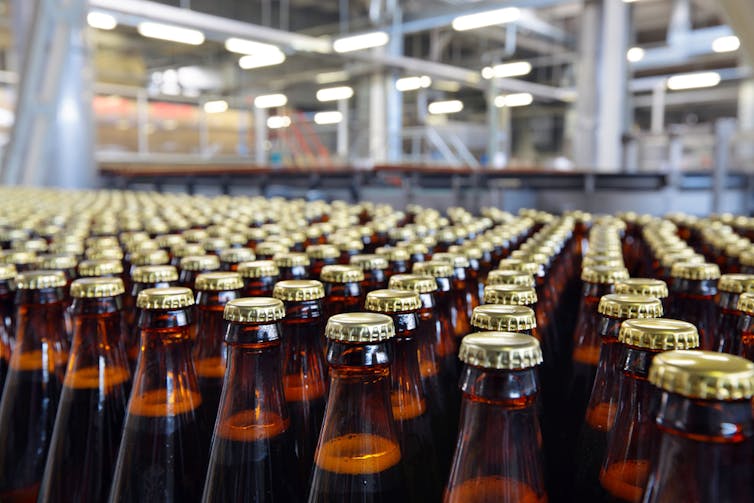
The drinks industry relies on heavy drinkers for the bulk of its revenue. Dmytro Zinkevych/Shutterstock.com

Responsible deal?

One of the few alcohol policies of any note to come out of Westminster in the past eight years was the so-called “responsibility deal”, in which over 100 alcohol makers and sellers committed to “foster a culture of responsible drinking, which will help people to drink within the guidelines”.
Later research showed that this commitment led to little in the way of meaningful change and is unlikely to have achieved these goals.
The Conversation
In highlighting the implausibility of the alcohol industry’s argument that it wants a world where everyone drinks moderately, our analysis suggests that this approach was doomed from the outset. Large sections of the industry would not survive if this were to happen, calling into question whether it is appropriate to include them in decisions about future alcohol policy.

Colin Angus, Research Fellow in the Sheffield Alcohol Research Group, University of Sheffield

This article was originally published on The Conversation. Read the original article.