HEDS is part of the School of Health and Related Research (ScHARR) at the University of Sheffield. We undertake research, teaching, training and consultancy on all aspects of health related decision science, with a particular emphasis on health economics, HTA and evidence synthesis.
Showing posts with label Tuberculosis. Show all posts

Monday, 16 April 2018

New estimate suggests a quarter of the world's population has latent tuberculosis

Following on from an earlier blog post on this site, HEDS Pete Dodd, University of Sheffield and Rein Houben, London School of Hygiene & Tropical Medicine have written a piece for The Conversation. about the new estimate that suggests a quarter of the world's population has latent tuberculosis

In rich countries, tuberculosis is sometimes thought of as a thing of the past, the disease that claimed Keats, Poe, Chopin. But globally, TB is today the number one infectious killer, causing an estimated 1.8m deaths in 2015.

Unlike many bugs, infection with the bacterium that causes TB doesn’t usually result in disease. The usual dictum is that only 10% of people who are infected will ever develop TB, but this may occur many years after initial infection. The flip side of this is that latent infection with Mycobacterium tuberculosis is far more common than the disease – and it is commonly stated that a third of all people worldwide carry it.
However, the last systematic attempt to estimate the number of latent TB infections was 20 years ago. Since then, many things have changed. The world population has increased by over 20% and grown older; in China, the median age has increased by ten years over this period. At the same time, children make up nearly half of the population in most sub-Saharan countries in Africa.

The fraction of people with TB disease has declined, despite upswings associated with HIV in some regions through the nineties. Developing new ways to address the pool of latent TB infection is now seen as an emerging front in its control. Clearly it’s time to reevaluate the “one-third” figure, which has become an oral tradition.

In a new paper published in PLOS Medicine, we reconstructed the “force of infection” for TB – the chance that an individual would become infected with Mycobacterium tuberculosis – in 180 countries (equivalent to about 99% of the world’s population) over the past 80 years. We approached this by compiling data from surveys testing for latent infection, largely prior to 1990. After 1990, we used estimates from the World Health Organisation on the prevalence of TB, and data relating prevalence to infection risk. The further back our estimates went, the more uncertain they became, especially for countries where data is sparse. So we took account of this uncertainty in our analyses. Applying these historical trends in infection risk to the demographic breakdowns of each country, we could work out what proportion of people in each age group was likely to have a latent TB infection.

We found that closer to a quarter of today’s global population has a latent TB infection – around 1.7 billion people. More than 80% of this burden is concentrated in Asia and Africa, where it is usually concentrated in older age groups as the prevalence of infection increases with age. Despite this, we estimate that nearly 100m children (more than the entire population of Germany) already carry a latent TB infection.
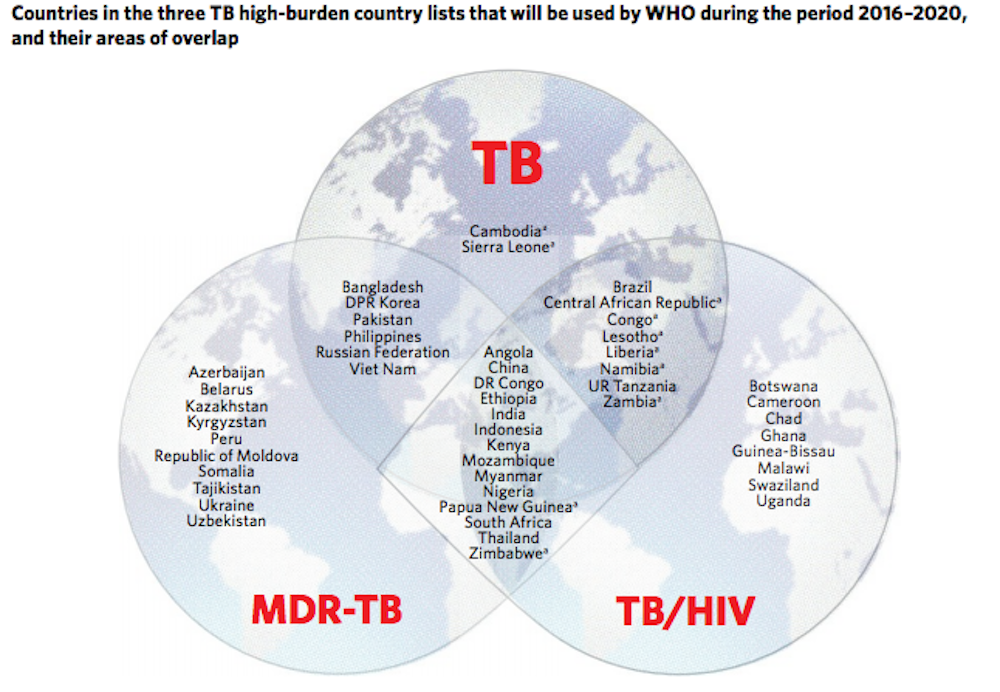
Country overlaps with TB, multi-drug resistant TB, and HIV related TB. WHO Global Tuberculosis Report 2016

We also worked out that even if all TB transmission stopped tomorrow, the current pool of 1.7 billion latent infections alone would prevent the number of those with TB from reaching the global targets set by the World Health Organisation for 2035, and the vision for TB elimination by 2050.

It is clear that if we really want to make TB a disease of the past, we will need to address this pool of 1.7 billion. New diagnostic tools are needed accurately to identify those individuals with latent TB infections that are likely to progress to disease, and new tools are needed to safely treat them. Only then can the current guidelines for latent TB infection be expanded from their focus on relatively small high risk groups (for example recent close contacts of individuals with TB or those infected with HIV) to reach a wider population.
The ConversationThe sheer numbers of those infected show that TB is not only still with us, it also needs to become a priority if we are going to address this ancient disease that still infects over a billion people, including 100m children, and causes more than 10m cases of disease and nearly 2m deaths each year. It’s much more than a numbers game, TB is a deadly reality.
Pete Dodd, Research Associate in Health Economic Modelling, University of Sheffield and Rein Houben, Associate Professor in Infectious Disease Epidemiology, London School of Hygiene & Tropical Medicine

This article was originally published on The Conversation. Read the original article.

Thursday, 29 March 2018

Pete Dodd involved in largest ever study on impact of TB and HIV interventions

Dr Pete Dodd of HEDS is part of a new EUR 12.9 million project, measuring the impact of a combination TB and HIV intervention when delivered to the entire population of 14 urban, high prevalence communities in South Africa and Zambia.
TB and HIV are the leading infectious causes of death worldwide – in 2016 1.7 million people died of TB. For people living with HIV, TB is the most significant co-infection, 40 percent of HIV deaths in 2016 were due to TB. The TREATS project [Tuberculosis Reduction through Expanded Anti-retroviral Treatment and Screening] was developed in response to this.
“TREATS is a unique opportunity to assess a combined TB and HIV intervention on a massive scale,” said Dr Helen Ayles, TREATS Project Director, Professor of Infectious Diseases at London School of Hygiene & Tropical Medicine and Research Director at Zambart. “It will provide amazing data and hopefully some practical solutions to end TB. TB is a curable illness, but in order to better reach people with treatment, we need to understand the epidemiology of the disease better. This is true active case-finding.”
Dr Pete Dodd
Dr Pete Dodd, Research Fellow, ScHARR

"Globally, one person is dying every 20 seconds or so from TB, which is a curable disease," said Dr Dodd, research fellow in mathematical modelling at ScHARR. "Timely access to diagnosis and appropriate care are huge issues, and in sub-Saharan Africa, HIV is still a major driver of the TB epidemic. This is a tremendously exciting opportunity to find out at scale whether an aggressive combination going out and looking for TB cases, and really ramping up HIV prevention and treatment measures can bend the curve of the TB epidemic in some of the worst affected parts of the world."
We will be using mathematical models of TB and HIV transmission to interpret data from the trial: to better understand the epidemiology and also to unpick to components of the intervention and their effects. We'll be able to assess the cost-effectiveness of these interventions, project their impact if maintained over longer time frames, or if rolled out more widely, and consider what would happen in other settings or with tweaks to their configuration.
DR PETE DODD, RESEARCH FELLOW, SCHARR
TREATS consortium members include: London School of Hygiene &Tropical Medicine, Imperial College London, Zambart, KNCV Tuberculosis Foundation, Sheffield University, the International Union Against Tuberculosis and Lung Disease (The Union), Health Systems Trust, Delft Imaging Systems and QIAGEN.
The EUR 12.9 million project is part of the European & Developing Countries Clinical Trials Partnership, (EDCTP2 programme) supported by the European Union.
For further information, please see the TREATS project webpages.

Thursday, 3 November 2016

New estimate suggests a quarter of the world’s population has latent tuberculosis

Image of Pete Dodd
Pete Dodd
Pete Dodd, from HEDS University of Sheffield and Rein Houben, London School of Hygiene & Tropical Medicine have written an article for The Conversation discussing their research into latent tuberculosis.

In rich countries, tuberculosis is sometimes thought of as a thing of the past, the disease that claimed Keats, Poe, Chopin. But globally, TB is today the number one infectious killer, causing an estimated 1.8m deaths in 2015.

Image of Rein Houben
Rein Houben
Unlike many bugs, infection with the bacterium that causes TB doesn’t usually result in disease. The usual dictum is that only 10% of people who are infected will ever develop TB, but this may occur many years after initial infection. The flip side of this is that latent infection with Mycobacterium tuberculosis is far more common than the disease – and it is commonly stated that a third of all people worldwide carry it.

However, the last systematic attempt to estimate the number of latent TB infections was 20 years ago. Since then, many things have changed. The world population has increased by over 20% and grown older; in China, the median age has increased by ten years over this period. At the same time, children make up nearly half of the population in most sub-Saharan countries in Africa.

The fraction of people with TB disease has declined, despite upswings associated with HIV in some regions through the nineties. Developing new ways to address the pool of latent TB infection is now seen as an emerging front in its control. Clearly it’s time to reevaluate the “one-third” figure, which has become an oral tradition.

In a new paper published in PLOS Medicine, we reconstructed the “force of infection” for TB – the chance that an individual would become infected with Mycobacterium tuberculosis – in 180 countries (equivalent to about 99% of the world’s population) over the past 80 years. We approached this by compiling data from surveys testing for latent infection, largely prior to 1990. After 1990, we used estimates from the World Health Organisation on the prevalence of TB, and data relating prevalence to infection risk. The further back our estimates went, the more uncertain they became, especially for countries where data is sparse. So we took account of this uncertainty in our analyses.

Applying these historical trends in infection risk to the demographic breakdowns of each country, we could work out what proportion of people in each age group was likely to have a latent TB infection.

We found that closer to a quarter of today’s global population has a latent TB infection – around 1.7 billion people. More than 80% of this burden is concentrated in Asia and Africa, where it is usually concentrated in older age groups as the prevalence of infection increases with age. Despite this, we estimate that nearly 100m children (more than the entire population of Germany) already carry a latent TB infection.


Country overlaps with TB, multi-drug resistant TB, and HIV related TB. WHO Global Tuberculosis Report 2016

We also worked out that even if all TB transmission stopped tomorrow, the current pool of 1.7 billion latent infections alone would prevent the number of those with TB from reaching the global targets set by the World Health Organisation for 2035, and the vision for TB elimination by 2050.

It is clear that if we really want to make TB a disease of the past, we will need to address this pool of 1.7 billion. New diagnostic tools are needed accurately to identify those individuals with latent TB infections that are likely to progress to disease, and new tools are needed to safely treat them. Only then can the current guidelines for latent TB infection be expanded from their focus on relatively small high risk groups (for example recent close contacts of individuals with TB or those infected with HIV) to reach a wider population.
The sheer numbers of those infected show that TB is not only still with us, it also needs to become a priority if we are going to address this ancient disease that still infects over a billion people, including 100m children, and causes more than 10m cases of disease and nearly 2m deaths each year. It’s much more than a numbers game, TB is a deadly reality.

The Conversation
Pete Dodd, Research Associate in Health Economic Modelling, University of Sheffield and Rein Houben, Associate Professor in Infectious Disease Epidemiology, London School of Hygiene & Tropical Medicine
This article was originally published on The Conversation. Read the original article.