HEDS is part of the School of Health and Related Research (ScHARR) at the University of Sheffield. We undertake research, teaching, training and consultancy on all aspects of health related decision science, with a particular emphasis on health economics, HTA and evidence synthesis.
Showing posts with label Collaborations. Show all posts

Wednesday, 8 January 2020

Professor Simon Dixon invited to speak at the 2019 UK-China Health and Economy Partnership in Beijing

Our own Professor Simon Dixon was invited to speak at the 2019 UK-China Health and Economy Partnership in Beijing. Also in attendance was academics from other high ranking universities. Professor Dixon spoke on collaborations and development in the pharmacoeconomics, economics and the economic evaluation of the use of drugs in medicine.
Image of 2019 UK-China Health and Economy Partnership
2019 UK-China Health and Economy Partnership
Professor Dixon from the University of Sheffield said: "The most non-academic benefit is that our research will improve health systems and decision-making, which will allow hospitals to treat more patients with the same amount of money and will benefit the quality and length of life of patients in both countries."

Keynote speakers included professors drawn from Bournemouth University, the
University of Sheffield, the University of York, the University of Leeds, Zhejiang
University, Fudan University and Shandong University.

The partnership is overseen by the British Council,and aims to create measurable benefits for Chinese patients and the economy by generating new health economics expertise.

The meeting was also covered by 中国教育在线 (China Education Online) and 环球网
(Global.com)


Monday, 4 November 2019

HEDS Collaboration to improve mental health in Uganda

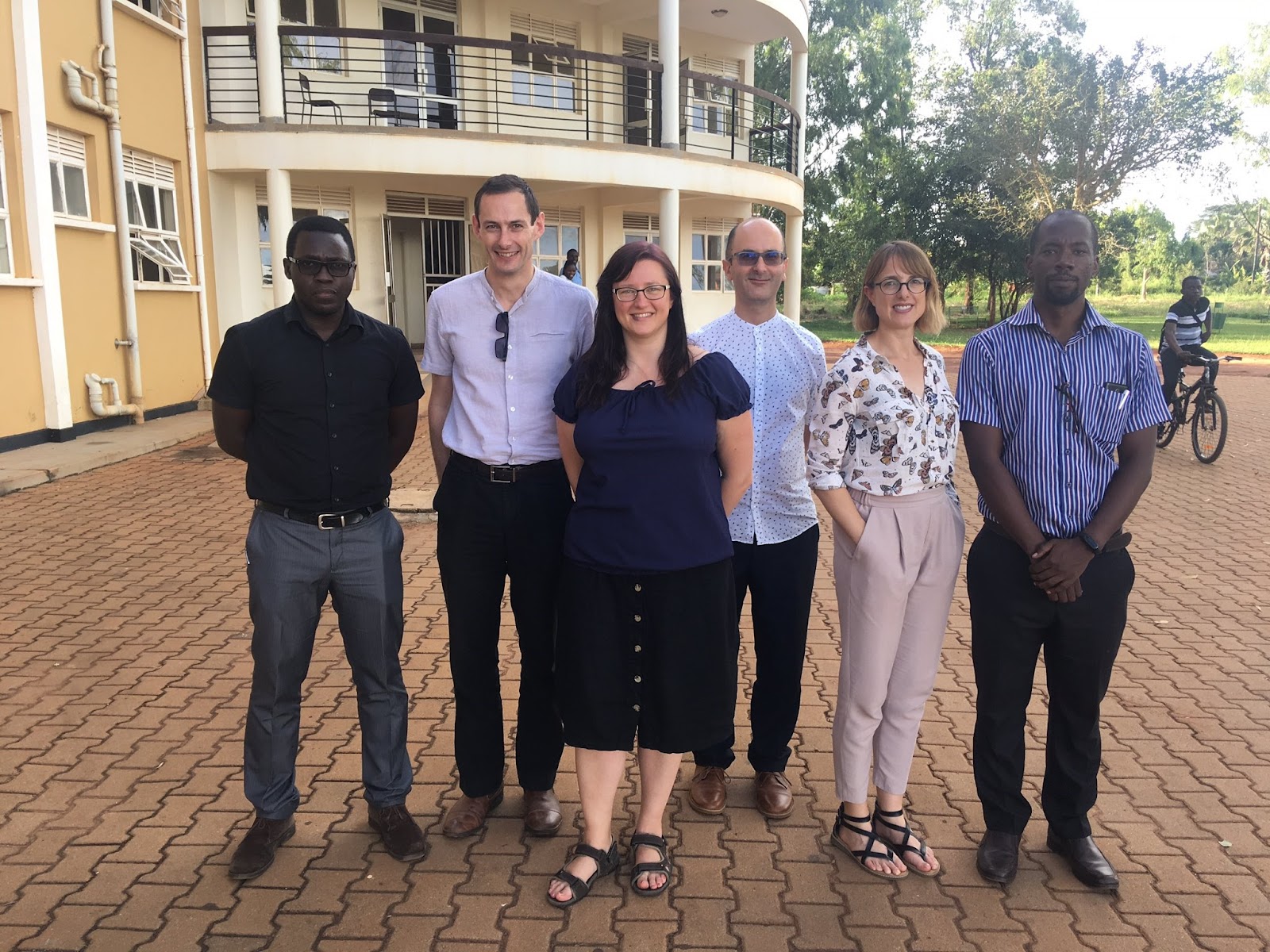
A group of researchers from The University of Sheffield including HEDS’ Mark Clowes recently returned from a field trip to Gulu in northern Uganda.

The visit was arranged as part of the long-established Gulu-Sheffield Mental Health Partnership which aims to exchange expertise between academics and health professionals in the two countries, and to develop skills on both sides.

The current project, which is led by Dr Andrew Thompson (Psychology), and funded by a GCRF seedcorn grant, aims to develop low intensity, culturally appropriate psychological interventions for common mental health conditions, with an emphasis on sustainability and capacity building. 

Image of Dr Anyayo Lucas, Dr. Andrew Thompson, Sian Johnson, Mark Clowes, Dr. Veronica Barnsley and Dr. Mpamizo Emmanuel
L to R: Dr Anyayo Lucas, Dr. Andrew Thompson, Sian Johnson, Mark Clowes, Dr. Veronica Barnsley and Dr. Mpamizo Emmanuel


During a productive visit, the team (which also included Dr. Veronica Barnsley from the School of English, and Sian Johnson from Sheffield Health & Social Care NHS Foundation Trust), were welcomed by the Uganda-UK Health Alliance, as well as by key players in government and non-governmental organisations; they also visited primary and secondary health care settings and held meetings with invited front-line staff to gain an understanding of the local context and specific challenges.

One of the first deliverables of the project will be a review of the existing literature around interventions for substance misuse in lower and middle income countries (due early 2020 and being led by Mark in collaboration with Dr Mpamizo Emmanuel (Gulu University) and Dr Anyayo Lucas (Lira University).  Beyond this the team will use a collaborative approach to develop interventions targeting the widespread problem of alcohol misuse. 

Wednesday, 5 June 2019

HEDS modellers become first non-US contributors to an ICER review

Image of Praveen Thokala
Dr Praveen Thokala


Dr Praveen Thokala and Professor Matt Stevenson recently provided economic modelling expertise for an Institute for Clinical and Economic Review (ICER) assessment on spinal muscular atrophy.  ICER, which was founded in 2006, is a not-for-profit organisation that evaluates the clinical and economic value of prescription drugs, medical tests and other health care delivery systems and effectively acts as an independent “watchdog” on drug pricing in the USA.


Image of Matt Stevenson
Professor Matt Stevenson
Each completed ICER assessment establishes a “value-based price benchmark” recommending  an optimal price point to reflect its long term outcomes for patients.  These recommendations are increasingly used to inform decisions by health insurance companies in the USA as well as Medicare in New York state and    retail pharmacist CVS, and have also been used by drug makers to help determine launch prices or the degree of discounts that will be offered.

ICER conducts its own in-house assessment of the clinical effectiveness of new drugs but commissions universities to create models of cost-effectiveness on which its price recommendations are based.  ScHARR is the first non-US institution to be commissioned to do this work.

The report, which assesses the comparative clinical effectiveness of Spinraza and Zolgensma in the treatment if SMA, is available (along with slides from Prof. Stevenson’s presentation) at: https://icer-review.org/topic/sma.

Thursday, 16 May 2019

New HEDS Project - Capacity building for improving the development of maternal health guidelines in Ghana

Image of Dr Edith Poku
Dr Edith Poku
Dr Edith Poku from HEDS is supporting a new project; 'Capacity building for improving the development of maternal health guidelines in Ghana' The proposed project comprises an initial networking and priority setting event, an Evidence skills masterclass and a rapid review of existing maternal guidelines in Ghana, led by collaborators in Ghana with support from the ScHARR team. 

The networking event held at the Kumasi Collaborative Centre for Research, Ghana ran from 13 to 14 March 2019 and brought together key stakeholders who discussed issues relating to ending preventable maternal mortality. Participants also shared their experiences about  maternal guideline development, implementation and evaluation. The event helped to identify opportunities and barriers relating to the development and implementation of evidence-based maternal health clinical guidelines in resource-constraint settings like Ghana. At the end of the event, identified issues were categorised and prioritised to inform a comprehensive research agenda. Additionally, a multidisciplinary team of guideline 'champions' was formed and commissioned to undertake a systematic review of available local guidelines of management of postpartum haemorrhage, hypertension in pregnancy and sickle cell disease in pregnancy.

Thursday, 29 March 2018

Pete Dodd involved in largest ever study on impact of TB and HIV interventions

Dr Pete Dodd of HEDS is part of a new EUR 12.9 million project, measuring the impact of a combination TB and HIV intervention when delivered to the entire population of 14 urban, high prevalence communities in South Africa and Zambia.
TB and HIV are the leading infectious causes of death worldwide – in 2016 1.7 million people died of TB. For people living with HIV, TB is the most significant co-infection, 40 percent of HIV deaths in 2016 were due to TB. The TREATS project [Tuberculosis Reduction through Expanded Anti-retroviral Treatment and Screening] was developed in response to this.
“TREATS is a unique opportunity to assess a combined TB and HIV intervention on a massive scale,” said Dr Helen Ayles, TREATS Project Director, Professor of Infectious Diseases at London School of Hygiene & Tropical Medicine and Research Director at Zambart. “It will provide amazing data and hopefully some practical solutions to end TB. TB is a curable illness, but in order to better reach people with treatment, we need to understand the epidemiology of the disease better. This is true active case-finding.”
Dr Pete Dodd
Dr Pete Dodd, Research Fellow, ScHARR

"Globally, one person is dying every 20 seconds or so from TB, which is a curable disease," said Dr Dodd, research fellow in mathematical modelling at ScHARR. "Timely access to diagnosis and appropriate care are huge issues, and in sub-Saharan Africa, HIV is still a major driver of the TB epidemic. This is a tremendously exciting opportunity to find out at scale whether an aggressive combination going out and looking for TB cases, and really ramping up HIV prevention and treatment measures can bend the curve of the TB epidemic in some of the worst affected parts of the world."
We will be using mathematical models of TB and HIV transmission to interpret data from the trial: to better understand the epidemiology and also to unpick to components of the intervention and their effects. We'll be able to assess the cost-effectiveness of these interventions, project their impact if maintained over longer time frames, or if rolled out more widely, and consider what would happen in other settings or with tweaks to their configuration.
DR PETE DODD, RESEARCH FELLOW, SCHARR
TREATS consortium members include: London School of Hygiene &Tropical Medicine, Imperial College London, Zambart, KNCV Tuberculosis Foundation, Sheffield University, the International Union Against Tuberculosis and Lung Disease (The Union), Health Systems Trust, Delft Imaging Systems and QIAGEN.
The EUR 12.9 million project is part of the European & Developing Countries Clinical Trials Partnership, (EDCTP2 programme) supported by the European Union.
For further information, please see the TREATS project webpages.

Wednesday, 11 October 2017

HEDS international visit to Centre for Infectious Disease Epidemiology and Research

Image of Dr Bell Gorrod with Dr Michael Schomaker, and Professor Mary-Ann Davies
Dr Bell Gorrod with Dr Michael Schomaker,
and Professor Mary-Ann Davies
Dr Helen Bell Gorrod recently visited the Centre for Infectious Disease Epidemiology and Research (CIDER) at the University of Cape Town (UCT). Helen successfully obtained funding for the visit from the Worldwide University Network (WUN) Research Mobility Programme (RMP). 

During the month long visit, Helen worked on a collaborative research project with Dr Michael Schomaker, Professor Mary-Ann Davies and others at UCT. 

The project aimed to assess the impact of delays in viral load testing and treatment switching from first-line to second-line ART treatment regime for HIV patients on hospitalisation and mortality outcomes using causal inference statistical methods. 

Thursday, 15 June 2017

NICE to work with ScHARR on developing new ways to measure quality of life across health and social care

NICE is taking part in a project that will examine how quality of life measures used to evaluate healthcare treatments such as drugs can be extended into areas of social care and public health. NICE to work with partners on developing new ways to measure quality of life across health and social care

The research, called the ‘Extending the QALY’ project, is being led by the School of Health and Related Research (ScHARR) at the University of Sheffield, with collaborators from the University of Kent, the Office of Health Economics and the EuroQol Research Foundation.

The project is being co-funded by a grant from the Medical Research Council (MRC) and the EuroQol Research Foundation. 


When NICE looks at the cost effectiveness of a healthcare intervention such as a new drug or diagnostic, the benefit of the intervention is measured in terms of how many quality-adjusted life years (QALYs) it provides. The ‘quality’ adjustment is based on a measurement of health-related aspects of quality of life.

However, some people feel that the existing measures of health-related quality of life might not capture important benefits of treatments beyond health-related quality of life, such as independence or improved relationships with friends, family and carers.

At the same time, different measures are used in healthcare, social care and public health, making it difficult to compare across these sectors, which is important when thinking about the wider health and social care budget.

The ‘Extending the QALY’ project will explore these issues and look at the importance of other aspects, such as social and emotional wellbeing, as well as physical and mental health. 


Image of scrabble words spelling the word Research
CC BY 2.0 Thomas Haynie http://bit.ly/2t28VES

Nick Crabb (Programme Director, Scientific Affairs) at NICE said: “NICE relies on an accurate assessment of quality of life when making decisions about interventions across health and social care. Research is needed  to develop new tools to assess quality of life that are equally relevant across these sectors and capture the key things – not just health – that are important to people. We look forward to working with our partners on this important project which aims to develop a new broad generic measure of quality of life that is relevant across health and social care. Depending on the research results, NICE will consider whether and how to include any new quality of life measure in its work.”

The project began in May 2017 and will last two and a half years. During this time the team will conduct interviews and surveys with patients, social care users, carers and the general public to explore what aspects of quality of life are important and identify the best questions to ask to measure quality of life. 


The original news story appears on the NICE website